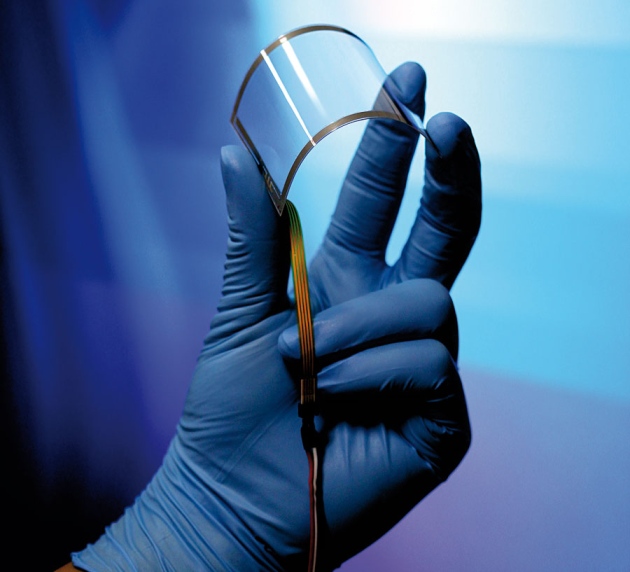
The Korean Research Institute of Chemical Technology (KRICT) has fabricated the first Perovskite Solar Cell with efficiency higher than 20 %. An exact value of 20.1 % has been certified by the NREL and it now appears in the updated efficiency chart. This new efficiency increase situates Perovskites very close to some of the Crystalline Silicon technologies, CdTe and CIGS solar cells.
Information on energy devices, materials science, and my research activity
19 November 2014
07 November 2014
New Website of the Cardiff Thermoelectric and Photovoltaic Laboratory
I am pleased to announce the launch of the new website of the Cardiff Thermoelectric and Photovoltaic Laboratory. It was released few weeks ago and there you can look at all the members that form the Laboratory, the funded projects we are involved in, our research lines and a detailed section with all our facilities. This is the website address: www.thermoelectric.engineering.cf.ac.uk
30 October 2014
Perovskite Solar Cells Moving On
I would like to highlight a recent article by Michael Grätzel published in Nature Materials which shows in my opinion a very nice view of the emergence, development, and problems to be addressed in the field of Perovskite Solar Cells. The article covers all the relevant aspects of this novel technology in a brief and clear way, which results very helpful for those non-familiar with the topic or willing to contribute to it.
Special emphasis is given to the issues rising in the characterisation due to hysteresis effects, and the problems to be addressed in order for the technology to reach the market. In this respect, stability studies seem to be scarce and the high toxicity of Pb compounds has to be overcome by searching new perovskite materials.
27 October 2014
Top 10 Emerging Technologies for 2014
The World Economic Forum has published a relation of the the top 10 most promising technologies for 2014. Within the selected breakthroughs are the ones related to wearable electronics, storage of electricity, screenless displays and brain-computer interfaces. All these technologies offer solutions to important problems of our society and hence could make an important impact in the economic market. To see the whole list and a brief summary of their relevance, click here.
25 October 2014
The Art of Scientific Publication
ACS publications have compiled a list of 20 references that cover a wide range of issues and aspects related to scientific publications. It deals with the preparation of graphics, the role of corresponding authors, preparation of cover letters, rejection and acceptance and up to the reply to reviewers. It is an excellent guidance, made from the point of view of the own editors and worth looking at it. The link is here.
07 October 2014
The Prospects of Graphene Applications
Graphene has acquire an enormous interest in the scientific community due to its outstanding properties and the large range of applications it can be used. In this month's issue of Nature Nanotechnology, seven experts briefly comment their views in the potential and challenges in the realization of graphene-based products in a range of fields such as displays, inks, energy, corrosion, health and life science, biomolecular analysis and aerospace. The article can be read here.
(Graphene transparent screen from Nature journal)
02 October 2014
Remarks About Record SnSe Thermoelectric Material
Few months ago, a new article appeared in Physics Today describing some concerns and comments about the outstanding properties of the new SnSe material which has shown impressive thermoelectric properties recently. Advantages and disadvantages regarding practical considerations are also included in the article along with some comments from different recognised researchers and laboratories which offer very interesting and critical points of view.
01 September 2014
Novel Device for the Heat Flow Control
Since many years ago, we have achieved an excellent control over electronic currents and have created many devices that have produced a huge impact in our society and in the way we life. Transistors, for example, are part of these devices and form the nuclei of our computer, mobiles, etc. However, we are still far from achieving this control over heat flow, that is, over the phonons. The invention of devices able to manipulate heat transport could make an enormous impact, and recently, researchers from the University of California at Berkeley and Georgia State University have reported the first temperature-gated thermal rectifier devices using VO2 beams.
(Schematic operation and pictures of the novel thermal rectifiers. Picture obtained from the Nano Letters article)
The modification of the heat flux in the beams can be achieved by changing the device temperature, which controls the metallic and insulating nature of the oxide. Maximum heat suppression of 28% is observed below 340 K when mixed metallic and insulating phases coexist in the VO2 beam. Once the devices are heated above 340 K, they become completely metallic and behave as ordinary thermal conductors.
If you want to read more about the potential and recent advances in the control of phonons, I would recommend having a look to a very interesting review article appeared in Nature last year. the article highlights the new opportunities to thermally insulate buildings, reduce environmental noise, transform waste heat into electricity and develop earthquake protection. Sonic and thermal diodes, optomechanical crystals, acoustic and thermal cloaking, hypersonic phononic crystals, thermoelectrics, and thermocrystals could be the devices to create the next technological revolution in phononics.
29 June 2014
Thermoelectricity Online Course
For those interested in learning the fundamentals of thermoelectricity from a microscopic point of view, understand the operation of the devices and also learn about measurement of thermoelectric properties in nano-scaled materials and the whole system efficiencies, there is a very interesting course freely available at the nanoHub website.
The course is called "Thermoelectricity: From atoms to systems" and is given by Professors Datta, Lundstrom and Shakouri from Purdue University (USA). It is distributed in 5 weeks and fro the website you have access to the videos of the lectures, slides and quizs and exams. There is also a forum for discussions. From the video above you can have an idea of what the course is about.
13 May 2014
Record Efficiency in Thermoelectric Materials
This month has been reported in Nature the thermoelectric material with the highest efficiency (ZT=2.6 at 923 K) so far: SnSe. The main reason for the high ZT is the ultralow thermal conductivity (0.25 W/mK) which is similar to that of polymers. This breakthrough has been achieved at the Mercoury Kanatzidis' Group in Northwestern University (USA).
SnSe is probably the world’s least thermally conductive crystalline material, so it can get hot on one side while keeping cold the other side. In addition, it holds a high Seebeck coefficient (around 0.4 mV/K). These results demonstrate that a high efficiency can be realized in simple layered, anisotropic and anharmonic systems, offering an alternative to the most-followed strategy of nanostructuring in order to improve the efficiency of thermoelectrics.
Subscribe to:
Posts (Atom)